
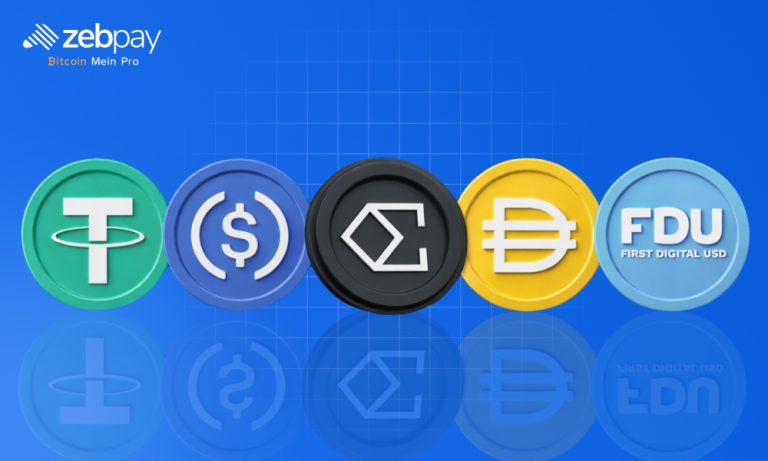
Stablecoins are a unique category of cryptocurrency designed to maintain a stable value, typically pegged to the US dollar. For Indian crypto investors, stablecoins serve important functions: preserving value during market downturns, facilitating trading, and accessing yield products. This guide covers the leading stablecoins available to Indian investors in 2026.
What is a Stablecoin?
A stablecoin is a cryptocurrency whose value is pegged to a reference asset, most commonly the US dollar. The idea is that 1 USDT (or 1 USDC, or 1 DAI) should always be worth approximately 1 US dollar.
Stablecoins achieve this peg through different mechanisms:
- Fiat-backed: Issuer holds actual USD reserves (USDT, USDC)
- Crypto-backed: Backed by other crypto assets with over-collateralisation (DAI)
- Algorithmic: Uses algorithms to maintain the peg (less common after high-profile failures)
1. USDT (Tether)
Issuer: Tether Limited Peg: 1 USDT = 1 USD Backing: Mix of cash, US Treasury bills, and other assets
USDT is the most widely used stablecoin globally by trading volume and market cap. It runs on multiple blockchains (Ethereum ERC-20, TRON TRC-20, BNB Chain BEP-20, and others). Available on ZebPay for INR trading.
Use cases: Trading base pair, value preservation during downturns, yield products Risk: Counterparty risk (Tether Limited’s reserve management)
2. USDC (USD Coin)
Issuer: Circle (in partnership with Coinbase) Peg: 1 USDC = 1 USD Backing: 100% backed by cash and short-dated US government securities, with regular audits
USDC is known for its transparency: Circle publishes regular reserve attestations by independent auditors. This makes USDC preferred by institutional users and DeFi protocols that prioritise reserve transparency.
Use cases: DeFi, institutional transfers, yield Risk: Issuer risk (Circle), regulatory risk (US-based issuer)
3. DAI
Issuer: MakerDAO (decentralised) Peg: 1 DAI = 1 USD Backing: Over-collateralised crypto assets (primarily ETH and stablecoins)
DAI is the leading decentralised stablecoin. It is not issued by a company; instead, it is generated by users who lock up crypto as collateral in MakerDAO’s smart contracts. This makes it more censorship-resistant than USDT or USDC.
Use cases: DeFi applications where censorship resistance matters Risk: Smart contract risk, collateral value risk (if backing assets fall sharply)
4. BUSD (Binance USD)
Status: Significantly reduced circulation since 2023 following regulatory action against Paxos (its issuer). BUSD is being phased out and its use has declined substantially.
Note: While BUSD is mentioned for completeness, it is no longer actively supported by many platforms. Check ZebPay for current availability.
5. PYUSD (PayPal USD)
Issuer: PayPal / Paxos Peg: 1 PYUSD = 1 USD Backing: USD deposits, US Treasuries
Launched by PayPal in 2023, PYUSD is a newer entrant backed by one of the world’s largest payment companies. Its growth has been relatively modest but it represents institutional interest in stablecoin infrastructure.
Use cases: Payments, transfers within the PayPal ecosystem Risk: Newer entrant, lower liquidity than USDT/USDC
Are Stablecoins Taxed in India?
Yes. Stablecoins are classified as VDAs in India. Gains from trading stablecoins are taxed at 30%, and 1% TDS applies on qualifying transactions.
In practice, gains from holding USDT are driven by USD/INR exchange rate changes (not crypto price movements). If the rupee weakens against the dollar, your USDT gains in INR are taxable.
Consult a qualified tax professional for advice specific to your situation. Tax rules are subject to change.
Frequently Asked Questions About Stablecoins in India
Is USDT available on ZebPay?
Yes. USDT is available for trading with INR on ZebPay.
Are stablecoins risk-free?
No. Stablecoins carry counterparty risk (issuer), reserve risk (backing), and potential de-peg risk. No stablecoin is 100% risk-free.
Which stablecoin network is cheapest for transfers?
TRC-20 (TRON) transfers of USDT typically have very low fees. ERC-20 (Ethereum) fees are higher and vary with network congestion.
Can I earn interest on stablecoins in India?
Check ZebPay’s Earn feature for available yield products on stablecoins. Always review terms and risks before participating.
What happened to BUSD?
Paxos, BUSD’s issuer, was ordered by the New York Department of Financial Services to stop minting BUSD in 2023. BUSD is being phased out and existing tokens can still be redeemed, but new issuance has stopped.
Final Thoughts
Stablecoins are a practical tool for Indian crypto investors: preserving value during market downturns, facilitating trading, and accessing yield products. USDT remains the most widely used, while USDC offers more reserve transparency.
All stablecoins carry risks. Understand the specific risks of each before holding significant amounts.
Get started today and join 6 million+ registered users exploring crypto investing on ZebPay!
Disclaimer: Crypto products and NFTs are unregulated and can be highly risky. There may be no regulatory recourse for any loss from such transactions. Each investor must do his/her own research or seek independent advice if necessary before initiating any transactions in crypto products and NFTs. The information in this article is for educational purposes only and does not constitute financial or investment advice.